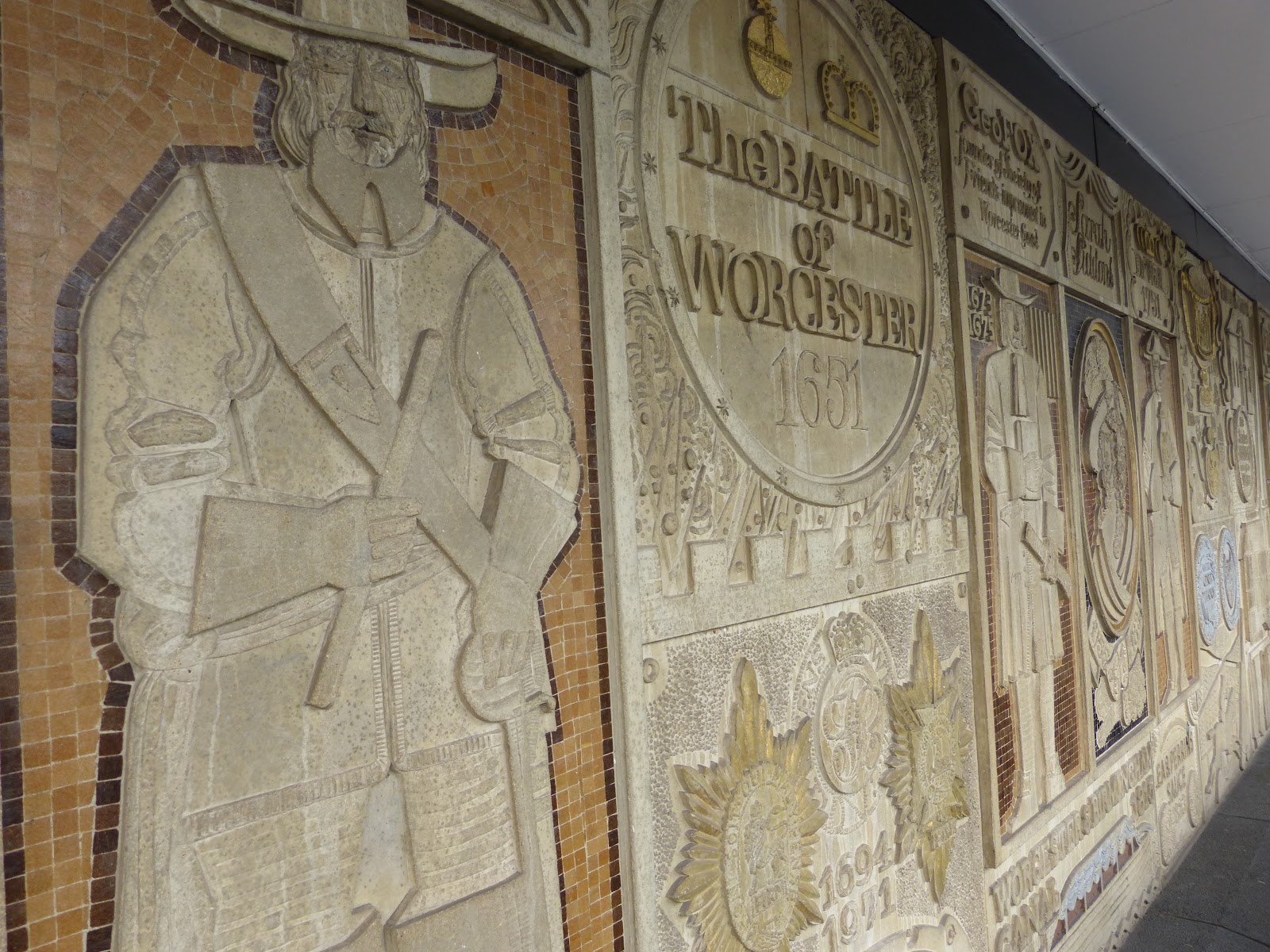
The Henry and Joyce Collins' mural in Worcester is another Sainsbury's commission. It is quite a considerable trek from the city centre to Windermere Drive in the Blackpole area, but well worth it when you get there.
The mural is in two sections, one of which was at the time of visit partially obscured by long row of waiting trolleys.
The mural follows the familiar pattern, covering numerous references to local history. There is an awful lot of detail, but luckily there is a plaque on each section which outlines what is shown.
Let's start with the left-hand panel. All the quotations in italics are the words from the plaque.
"VERTIS - Roman name for this settlement at Worcester"
"Figure of HWICCE chieftain"
"Food vessel and beaker period pot from City Museum"
"HWICCE Saxon name for local tribe"
"MERCIA, name of Kingdom, Coins gold stater REGNENSES tribe from City Museum"
"HAROLD II silver penny minted Worcester (1066 coin)"
"Symbols of sheep farming, wool basket, medieval plough, fishing."
"Sun motif. Weapons, flints and ornaments"
The sun motif is the symbol used on all the commissions for Sainsburys.
"Coin from the City Museum AETHELRED II, minted Worcester"
"Head of Green Man from cloister, arms from Beauchamp tomb King John tomb"
King John's tomb is the oldest surviving English royal effigy.
"Arms of county and city"
The city coat of arms has two shields - one with the castle, and a later addition of the pears (see reference to Elizabeth I below).
The black pears are also a feature of the county coat of arms, this time incorporating a whole tree. The county coat of arms is much more recent, being granted in 1947.
"WEOGERNACEASTER Anglo Saxon name of city"
"Cathedral history St Dunstan, St Oswald, St Wulstan"
Oswald (died 992) was also a Bishop of Worcester, and for a period was simultaneously Archbishop of York.
"Cathedral and shield with names of ecclesiastical worthies"
Construction of Worcester cathedral was begun by Bishop Wulfstan in 1084, but as with most ancient cathedrals it has a complicated architectural history.
The five arch stone bridge was started in 1771 and opened to traffic in 1780. It was subsequently widened and re-opened in 1932. The representation on the mural is below the two monarchs.
"Local fruit growing hops wine and vinegar"
The second panel is partially obscured by an impressively long time of idle trolleys (my visit occurring just after closing on a Sunday afternoon).
We have a repeat of the symbol used for Sainsburys by Henry and Joyce Collins.
"Oliver CROMWELL, CHARLES I. "The Faithful City". Battleground relics."
The dates 1642 and 1651 refer to the English Civil War in which Oliver Cromwell's forces defeated the Royalists. The first skirmish of the war was at nearby Powick in 1642, and the final battle was for the city of Worcester itself, where the Royalist army was defeated on 3 September 1651.
The image under the dates appears to be the decoration over the entrance to the current Guildhall.
"The Faithful City" is a reference to the city remaining supportive of the Royalist cause throughout the duration of the war.
"Geo. FOX, Quaker founder, imprisoned 1673 - 1675 in Worcester gaol"
George Fox (1624 -1691) did indeed found the Quaker movement. In the process of doing so he often went up against civil authority, and in consequence fell foul of laws on blasphemy, causing a public disturbance and similar. He can be seen as a career criminal, being first imprisoned in Nottingham in 1649, and then in Derby, Carlisle, London, Launceston, Leicester, Scarborough, and finally in Worcester in 1673.
"Sarah SIDDONS, 1755 - 1831, educated and acted in Worcester"
"Dr WALL, founder Royal Porcelain 1751"
"LEA & PERRINS sauce, 1823 WORCESTER and BIRMINGHAM canal opened 1815"
"Royal Worcester Porcelain"
Apart from the sauce, Worcester is perhaps best known for its porcelain.
"trade tokens from City Museum Horse racing, cricket, rowing"
"Charles HASTINGS, founder BMA"
"The Commandery, founded 1086 by WULSTAN"
""The Glovers Needle" on Deansway Glovers Trade Card"
The Glovers' Needle is the spire of St Andrews church, the main body of which was demolished in 1949. The spire and tower stand 75 metres tall, making it still the tallest building in Worcester. the name arises from glove making, which was a major industry in the city.
"Edward ELGAR, composer, 1857 - 1934 born at Broadheath"
Edward Elgar was a composer, best known for works such as the Enigma Variations, Pomp and Circumstance and The Dream Of Gerontius. His birthplace of Lower Broadheath is just to the north-west of the city. one useless fact is that there are 65 roads in the UK named after him.
The Three Choirs Festival is an annual music event rotated around the cathedrals (hence three choirs) of Hereford, Gloucester and Worcester.
"BERROW'S JOURNAL 1690, Britain's oldest newspaper"
Berrow's Worcester Journal was first published in 1690 and continues today as a free weekly paper, and thus claims to be Britain's oldest newspaper still in print.
I have barely scratched the surface in explaining the meaning behind all the image son this wonderful mural by Henry and Joyce Collins, but I hope have given you a flavour. Next stop - Droitwich.
Photographs taken on 14 July 2019.