
This was another commission by Sainsbury's and, as the plaque says, originally graced a store in the Lordshill area to the north of the city, but has now found a new home in the Old Town. Its location in Hamtun Street is the only one of the Collins' murals which I have seen marked as a feature on Google maps.

The mural dates from 1978, and, as so often in the case of the work of Henry and Joyce Collins, narrates the history of the city "from the Romans and Saxons to the modern docks and liners". I feel a need to look at that history in a little more detail, starting from the beginning.


The first images are of two ancient sailing ships, the second of which would appear to relate to the Norman invasion of 1066.


As this is a mural originally commissioned by Sainsburys, it has the usual circular emblem.


Which is not to be confused with this next element - judging by other Henry and Joyce Collins' murals and what I believe is the inscription "Pax Pultrum", I assume that this is a coin which was found in the local area.

Some of the old names for Southampton (Hamtun and Hamwih) are inscribed above the names of the two principal rivers in the city.

Above these names are several images, including the Bargate, the Norman gateway into the city, and some deer, which could be a reference to the nearby New Forest National Park.

We also have images of wine and wool, two of the principal goods on which the port of Southampton was founded (French wine coming into the country and British wool exported)


Now here's a test for you - can anyone identify either this ship or the badge next to it?


The Art Deco Ocean Terminal, which provided rail connection to the ocean liners, was built in 1950 (its throw-back architectural design was a result of construction being delayed for the war). Sadly it was demolished in 1983.


The centre of the mural is dominated by the city's coat of arms, which includes the two sailing ships.


The ship below the coat of arms must surely be RMS Titanic, which sailed from Southampton on 10 April 1912.


The section is completed by an image of sailing yachts and landmarks from the city. The yachts may just represent the prevalence of sailing in this area, or may be a specific reference to the America's Cup, which was first held in 1851 around the Isle of Wight immediately to the south of Southampton.


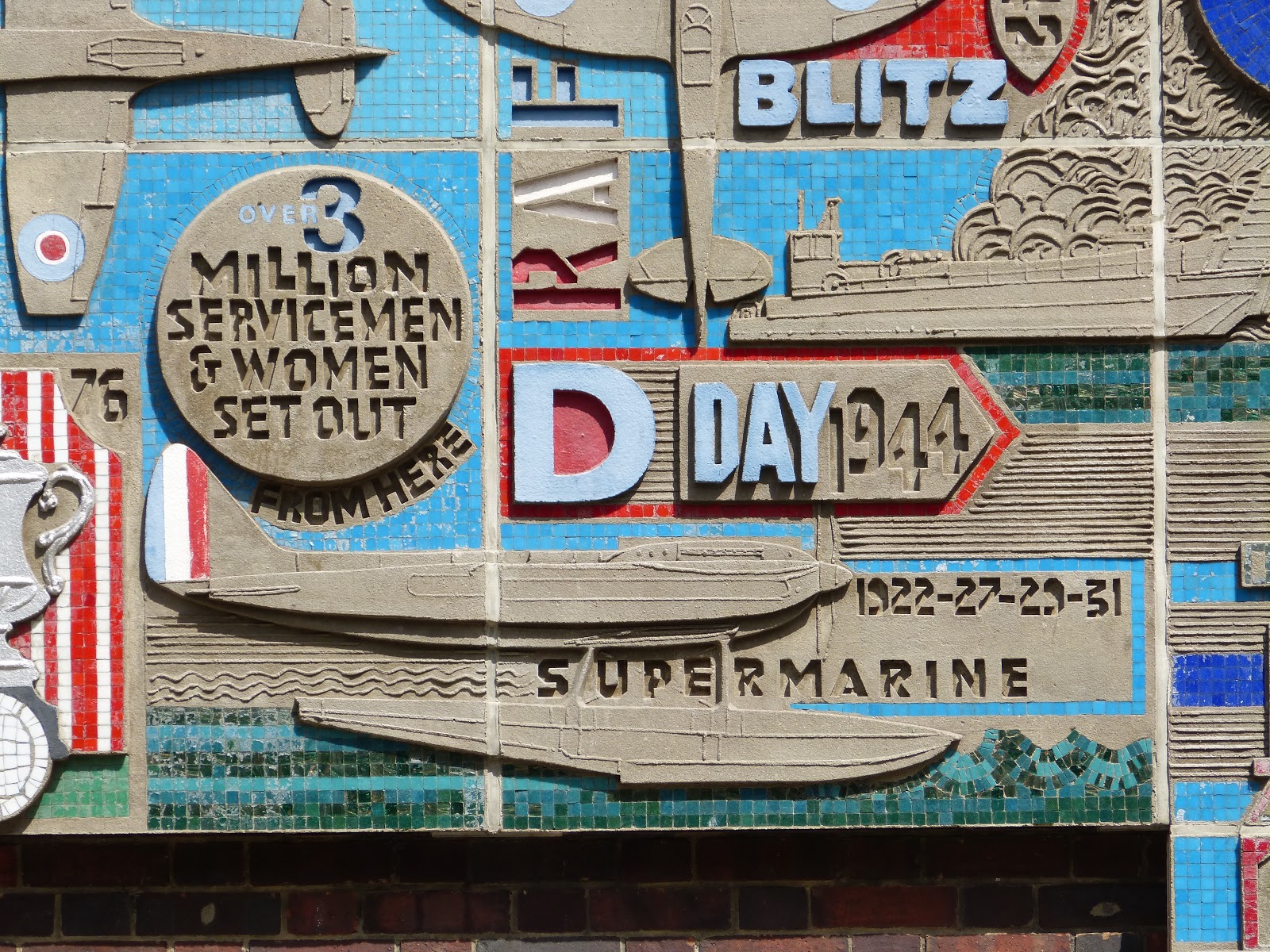
The next section of Henry and Joyce Collins' mural focuses on the Second World War.

The military references are to:
- the Spitfire (cue music and the sound of the Rolls Royce Merlin engine in your head), which was originally built in Southampton;
- the Blitz, with the city suffering from 57 attacks, with 2,300 bombs and 30,000 incendiary devices dropped, resulting in 45,000 buildings damaged or destroyed, and 631 people killed;
- the D-Day landings, with Southampton being a major launchpad for troops and equipment.


To battles of a different kind, the mural celebrates Southampton City's victory in the FA Cup in 1976, where they beat Manchester United 1-0.

The Schneider Trophy (competed by seaplanes from 1913 tom 1931) is also depicted, and references the wins made by Southampton-built Supermarine aircraft in 1922, 1927, 1929 and 1931 (with Sea Lion II, S.5, S.6 and S.6B planes respectively).

BTDB is the initials of the British Transport Dock Board, which was the nationalised docks authority established by the Transport Act 1962, and subsequently privatised. The logo I assume is a play on water and a docking bollard.

The final sections of the mural cover the docks and the ships that use them. The port is still very much active, and is the biggest cruise terminal and second largest container port in Britain.


The types of ships depicted include fast ferries, warships, bulk carriers, Isle of Wight ferries and cruise ships.


And the hovercraft service to the Isle of Wight, which is still running and has recently had new vessels introduced.

The final ship shown is the Queen Elizabeth 2, generally known as the QE2, which operated out of Southampton from 1969 to 2008.

And below QE2's hull we see the signature of Henry and Joyce Collins - Colchester (and just cut off from this picture, the date 1978).

I will leave you with some views of the whole mural.


Photographs taken on 25 May 2019.


